
CBA’s market weight: Unprecedented or just another giant?
There’s been a lot of noise around CBA’s valuation – at its peak, it traded at over 30x forward earnings and made up 12% of the Australian equity market. Media and brokers called it ‘unprecedented.’
But was it really?
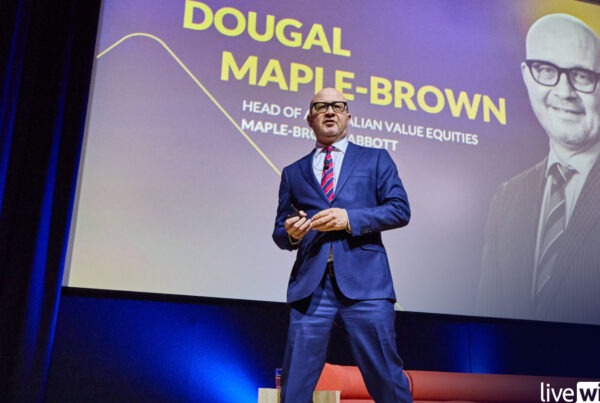
Dougal Maple-Brown reflects on his 25 years at Maple-Brown Abbott, charting the market weight of Australia’s biggest stocks at their peaks vs. today.
Disclaimer: This information was prepared and issued by Maple-Brown Abbott Ltd ABN 73 001 208 564, AFSL No. 237296 (“MBA”). This information is general information only and it does not have regard to any person’s investment objectives, financial situation or needs. Before making any investment decision, you should seek independent investment, legal, tax, accounting or other professional advice as appropriate, and obtain the relevant Product Disclosure Statement and Target Market Determination for any financial product you are considering. This information does not constitute an offer or solicitation by anyone in any jurisdiction. Past performance is not a reliable indicator of future performance. Any views expressed on individual stocks or other investments, or any forecasts or estimates, are point in time views and may be based on certain assumptions and qualifications not set out in part or in full in this information. The views and opinions contained herein are those of the authors as at the date of publication and are subject to change due to market and other conditions. Such views and opinions may not necessarily represent those expressed or reflected in other MBA communications, strategies or funds. Any companies, securities and or/case studies referenced or discussed are used only for illustrative purposes. The information provided is not a recommendation for any particular security or strategy, and is not an indication of the trading intent of MBA. Information derived from sources is believed to be accurate, however such information has not been independently verified and may be subject to assumptions and qualifications compiled by the relevant source and this information does not purport to provide a complete description of all or any such assumptions and qualifications. To the extent permitted by law, neither MBA, nor any of its related parties, directors or employees, make any representation or warranty as to the accuracy, completeness, reasonableness or reliability of the information contained herein, or accept liability or responsibility for any losses, whether direct, indirect or consequential, relating to, or arising from, the use or reliance on any part of this information. This information is current at 30 September 2025 and is subject to change at any time without notice. © 2025 Maple-Brown Abbott Limited.

BEc, LLB (Hons), FFIN, CFA
Dougal joined Maple-Brown Abbott in 2001 as an equity analyst. He is currently a portfolio manager and equities analyst. Dougal was an Executive Director from July 2009 to October 2018. Dougal’s responsibilities include equity analysis and portfolio management, including managing a large number of institutional and retail accounts. He attended the Advanced Management Program at Harvard Business School in 2014. Prior to joining Maple-Brown Abbott Dougal worked in a national law firm and at an international investment bank.
Dougal joined Maple-Brown Abbott in 2001 as an equity analyst. He is currently a portfolio manager and equities analyst. Dougal was an Executive Director from July 2009 to October 2018. Dougal’s responsibilities include equity analysis and portfolio management, including managing a large number of institutional and retail accounts. He attended the Advanced Management Program at Harvard Business School in 2014. Prior to joining Maple-Brown Abbott Dougal worked in a national law firm and at an international investment bank.
Board and committee membership:
Asset Allocation Committee
Dougal
Interested in investing with us?
Investment Insights
1 hour min
Dougal Maple-Brown’s shocking prediction
At Livewire Live, Dougal Maple-Brown, Head of Australian Value Equities, made a two-part "shocking prediction": CSL would double from its lows and Commonwealth Bank (CBA) would halve from its highs. Before he even took the stage, CSL had all but doubled from its May low of ~$90. Find out why Dougal believes valuation is behind both calls, why CBA could fall to $100 a share, and why we are overweight healthcare for the first time in decades.

8 min
Data center growth in Iberia
In the current environment of strong and growing electricity demand, the nature of investment opportunities continue to evolve. On our September research trip to Portugal, Spain, the UK and the US, we found two opportunities we believe the market is under-appreciating. Europe’s data center growth is happening in Iberia; while battery storage investments are generating attractive returns for developers and addressing customer affordability for US regulated utilities. Read the full insights to see what we learned on the ground.


18 min
2026 Australian Small Companies ESG Report
The environment for responsible investment continues to evolve, and in certain markets the debate surrounding ESG has become increasingly polarised. Our position remains unchanged. We focus on the environmental, social and governance factors that are financially material to the companies held in the Fund, and on the management of those factors in the long-term interests of our investors. Where third-party coverage of the smaller end of the domestic market is thin, proprietary research and direct engagement with boards and management become the means by which that view is formed. Our ESG report for the Maple-Brown Abbott Australian Small Companies Fund records both over the 2026 financial year.


8 min
Beyond the chips five thematics from our US trip
Our recent US trip took us across five cities, meeting management teams, industry experts and policymakers. The most valuable insights emerge from the pattern that forms when dozens of conversations begin pointing the same way. This trip surfaced five thematics, from an AI build-out that is really a story about power and connectivity to structural defence spending and a resilient US consumer. We explore what each means for finding Australian small companies on the right side of these shifts.