

It’s not just about chips: what our recent US trip taught us about AI, defence and the consumer
During the June 2026 quarter, we spent two weeks on the ground in the United States in Dallas, Washington DC, New York, Seattle and San Francisco, meeting company management teams, industry experts and policymakers. Many were ASX-listed companies operating in the US, others were American corporates that sit upstream, downstream or squarely in competition with the Australian small companies we own in the Fund. The value of a trip like this is less about any single meeting and more about the pattern that emerges when dozens of conversations start pointing in the same direction. Five thematics stood out to us.
1. In AI infrastructure, the bottleneck is no longer just GPUs
The popular narrative to date of the AI build-out has mostly been the insatiable demand for compute and GPU chips. On the ground, almost nobody is talking about chips as the only binding constraint anymore. The conversation has shifted decisively to everything around chips: power, memory, networking equipment, and the skilled labour to install it all.
The most striking framing came from a specialist who described demand for compute as effectively existential, with commitments for GPU capacity running well ahead of what can physically be delivered. But the constraint isn’t silicon – it’s the power to run it and the transmission to deliver that power. US grid interconnection queues are running 2-3 years, which is pushing operators away from greenfield sites and toward retrofitting already energised industrial land, generating power on-site and, over a longer horizon, small modular reactors.
We heard the same message from the construction and electrical-equipment side of the chain: order books stretching well past 2027, contract ticket sizes stepping up, and margins improving as scale builds. A power-delivery contractor made the point that its real moat is not technology but craft labour, electricians and high-voltage specialists, and that it actively prefers tight labour markets because solving that scarcity is precisely what it gets paid for.
For an Australian small cap investor, this is the more durable place to fish. The picks and shovels of the AI build-out: power, cooling, electrical equipment, construction and the specialists who can deliver at scale, carry far more earnings visibility than trying to pick the winning AI model.
2. The ‘age of inference’ is quietly reshaping the network
There’s a growing distinction between training AI and the requirements to run it. Training the largest models requires enormous, densely packed, liquid-cooled campuses where tens of thousands of chips sit together and talk to each other. Inference, where using a trained model to answer a query, write code or run an agent, is different. A single chip can serve a request, and those workloads can be spread across many smaller, ordinary DCs and then stitched together by the network.
This matters because it opens capacity that the hyperscalers simply won’t touch, the sub-5MW deployments scattered across hundreds of existing colocation sites. Several companies we met, on both the network-connectivity and fibre sides, are positioning for exactly this shift, describing a ‘tsunami’ of demand from a new generation of software and coding companies that have gone from a standing start to hundreds of millions in ARR in barely a year. The insight the market has been slower to price is that all this distributed inference has to be connected. Connectivity, though a tiny share of a customer’s total AI spend, is used by 100% of customers and is impossible to design out.
3. Defence spending is structural, and the definition is widening
Our conclusion from meetings in Washington DC was unambiguous: defence spending has genuine bipartisan support in Congress, with the rate of rejection for defence measures is now running below 3% of members (below historical levels).
Two sub-themes stood out for us. First, the drone and counter-drone arms race is real and accelerating, from battlefield communications and signal-jamming to unmanned systems across the full spectrum of conflict, and it is drawing in acquirers, with the candid view that ‘half the drone companies out there are going to get bought’ because there simply aren’t enough government contracts to sustain them all. Second, AUKUS is driving an industrial base build-out that lands disproportionately in Australia, including submarine sustainment in WA, maintenance and shipbuilding precincts, munitions capacity, and the ‘Pillar 2’ advanced-technology ecosystem spanning autonomy, robotics and critical minerals. A licence-free framework between the partners is beginning to unlock IP transfer at scale.
One point we found telling: the emerging argument that the ‘S’ in ESG can be read as ‘Security’, positioning defence as compatible with institutional capital mandates. If that narrative takes hold with the super funds, it removes a long-standing constraint on capital flowing to the sector.
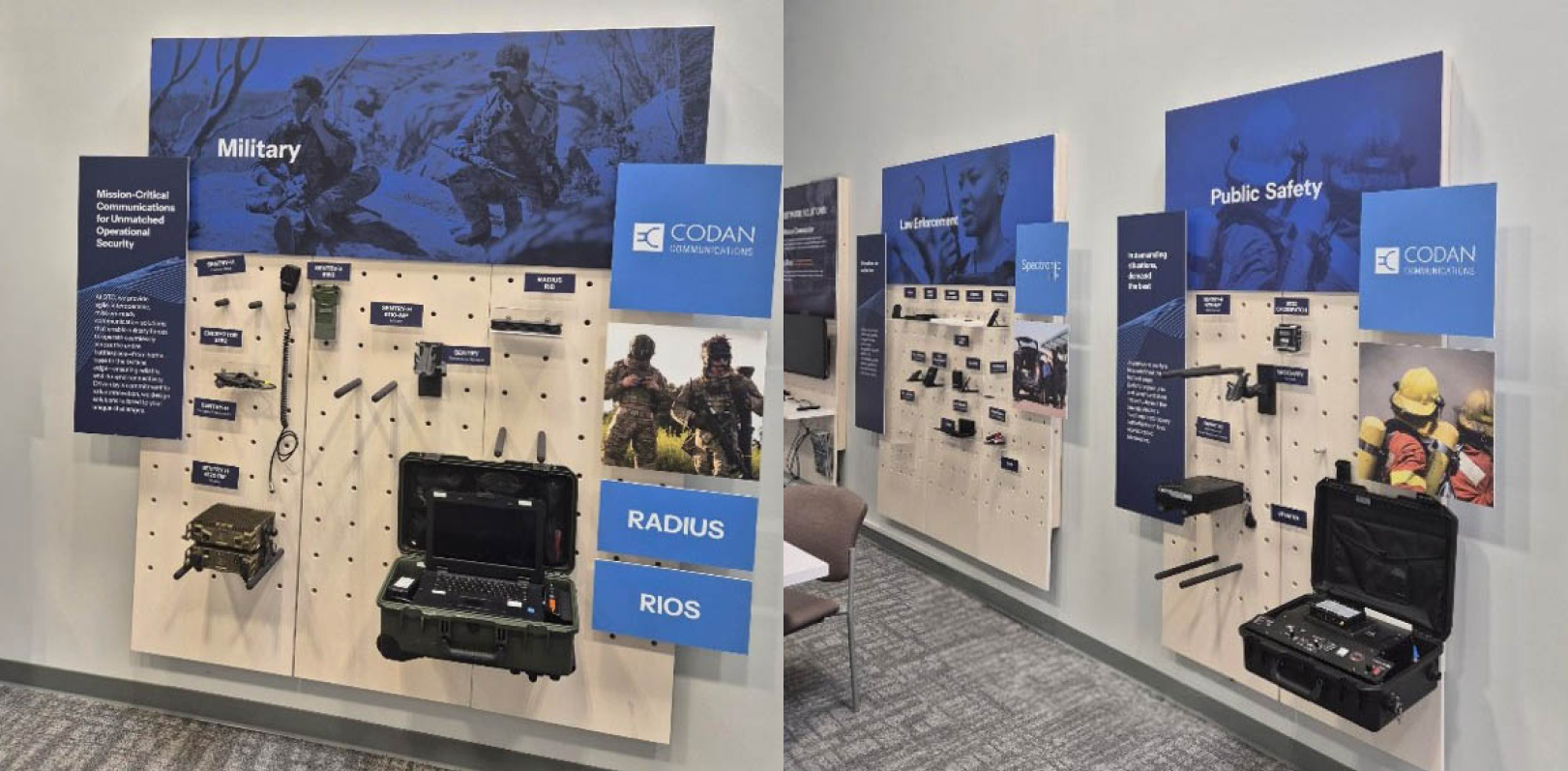 Codan (ASX: CDA) DTC business – Military, Public Safety and Law Enforcement mission critical communication infrastructure is seeing significant demand, Ashburn, Virginia.
4. Every company now has an ‘AI story’
Almost every company management team we met volunteered an AI narrative. Right now, the credible, measurable benefits are mostly on the cost side instead of using AI to generate revenues.
The examples were concrete and consistent. A consumer-finance business told us ~80% of its code is now AI generated and that it could ultimately run with a third fewer people. A retailer is handling approximately two thirds of call-centre volume through AI. A corporate-travel platform has AI agents fielding ~60% of requests that previously went to humans. A debt-collection company is using AI to draft legal documents. The outcome from all of this is business operating leverage (doing more with the same or fewer people).
The flip side is a genuine macro question: if AI displaces a meaningful share of white-collar workers, and white-collar workers account for ~60% of discretionary consumer spending, the second order effects are not trivial. We are watching the labour-substitution story closely, not only as a margin tailwind for companies deploying this strategy but also as a key risk to the consumer names downstream of it.
5. The US consumer is resilient but increasingly K-shaped
Consumer sector management teams were, on balance, more upbeat than the headlines would suggest, but with a clear split by cohort.
At the top end, spending is holding up well. A premium home retailer with an average customer income around US$150,000 described broad-based strength across the business and no change in customer behaviour. A consumer-credit business said its customer was ‘robust’, with no signs of stress and improving repayment trends. Lower down, the picture is softer: renovation and remodelling activity tied to existing-home sales, which are near all-time lows, has stalled, with the larger home-improvement projects that require home equity the most affected. Others flagged the coming roll-off of student-loan protections and higher fuel prices as pressures building on the more stretched end of the consumer.
The overall read vindicates a K-shaped economy: an upper cohort still spending freely, and a housing- and credit-sensitive cohort under gradual pressure. Ultimately, which side of the K a business serves is starting to increasingly matter.
Key takeaways
The thought across all five thematics is that the most investable opportunities are rarely obvious on the ASX. The AI trade, on the ground, looks less like a bet on models and chips and more like a bet on power, connectivity and the physical build-out, with key Fund holdings Megaport (MP1) and Southern Cross Electrical Engineering (SXE) expected to be key beneficiaries. The defence cycle looks increasingly structural, and we continue to see Codan (CDA) as being well positioned to benefit here. The AI productivity story is real, although the examples we come across are mostly focused on the cost line. The US consumer remains strong, and as a team, we’re focused on finding Australian small caps with exposure to this in the consumer and housing sectors.
Disclaimer
This information is prepared by Antipodes Partners Limited (“Antipodes”) (ABN 29 602 042 035, AFSL 481 580) as the Investment Manager of the Maple-Brown Abbott Australian Small Companies Fund (ARSN 658 552 688) (‘the Fund’). Maple-Brown Abbott Limited (‘MBAL’) (ABN 73 001 208 564, AFSL 237296), is the Responsible Entity of the Fund. MBAL and Antipodes are subsidiaries of Antipodes Partners Holding Limited (ABN 91 602 828 526). The Product Disclosure Statement (‘PDS’) and Target Market Determination (‘TMD’) of the relevant Fund are available via the links below. Any potential investor should consider the PDS and TMD before deciding whether to acquire, or continue to hold units in, the Fund.
Link to the Product Disclosure Statement
Link to the Target Market Determination
For historic TMD’s please contact MABL’s Client Service Phone +61 8059 7671 or Email invest@maple-brownabbot.com.
This information is for general information only. It is not intended as a securities recommendation or statement of opinion intended to influence a person or persons in making a decision in relation to investment. It has been prepared without taking account of any person’s objectives, financial situation or needs. Any persons relying on this information should obtain professional advice before doing so. Past performance is for illustrative purposes only and is not indicative of future performance.
Whilst Antipodes and MBAL believe the information contained on this webage is reliable, no warranty is given as to its accuracy, reliability or completeness and persons relying on this information do so at their own risk. Subject to any liability which cannot be excluded under the relevant laws, Antipodes and MBAL disclaim all liability to any person relying on the information contained on this webpage in respect of any loss or damage (including consequential loss or damage), however caused, which may be suffered or arise directly or indirectly in respect of such information. This disclaimer extends to any entity that may distribute this communication. Any opinions and forecasts reflect the judgment and assumptions of Antipodes and its representatives on the basis of information available as at the date of publication and may later change without notice. Any projections are estimates only and may not be realised in the future. Unauthorised use, copying, distribution, replication, posting, transmitting, publication, display, or reproduction in whole or in part of the information contained in this communication is prohibited without obtaining prior written permission from Antipodes. For more information, including our Financial Services Guide, visit maple-brownabbott.com.

William
Interested in investing with us?
Investment Insights
Dougal Maple-Brown’s shocking prediction


Data center growth in Iberia


2026 Australian Small Companies ESG Report


Beyond the chips five thematics from our US trip