
Key takeaways
- Annual General Meeting (AGM) season themes so far: Australian housing and retail are weakening; funding constraints are limiting pockets of growth; and cost pressures are squeezing margins.
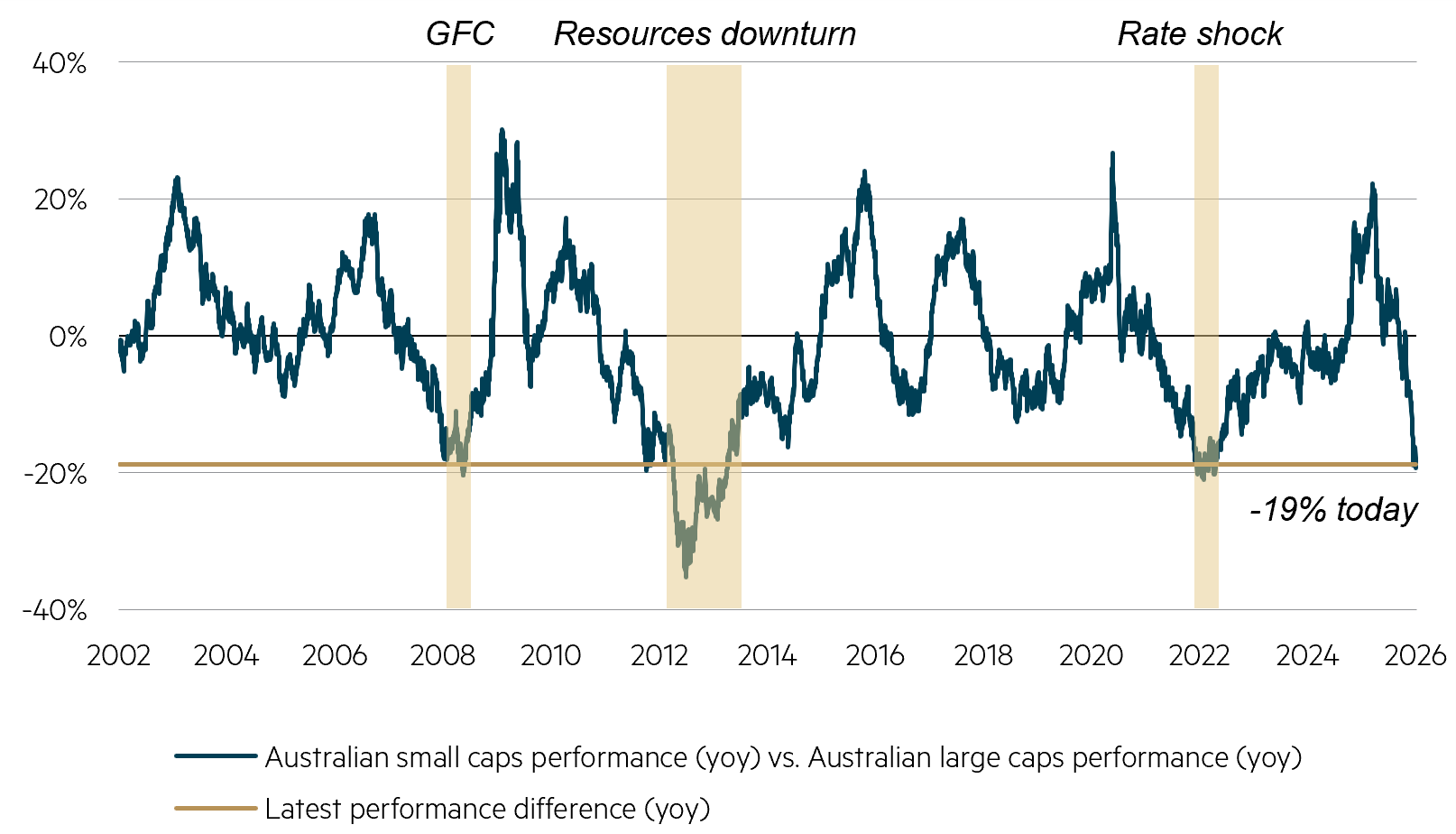
- A wide performance gap: Australian small caps have lagged large caps by almost 20% over the past year, a gap seen only three times since 2002.
- Five potential catalysts for a recovery: Peaking rates, attractive valuations, higher dividend yields than large caps, rising takeover interest and stronger forecast earnings growth.
- What it means for investors: The timing of an Australian small-cap recovery is uncertain, but past recoveries have often been swift once the rate cycle turned.
Australian small caps have trailed large caps by one of the widest margins in recent history. Like a coiled spring, that tension creates the potential for a sharp release. The Annual General Meeting (AGM) season so far has revealed where pressure is building, which companies are proving resilient and what could trigger a broader Australian small-cap recovery.
A rare performance gap, and history suggests it can close sharply
Australian small caps (S&P/ASX Small Ordinaries Index) have underperformed large caps (S&P/ASX 100 Index) by 19% over the past 12 months. October alone widened the gap by more than 8% as higher-than-expected inflation revived expectations of further interest rate rises, while elevated global bond yields, continued geopolitical tensions, artificial intelligence (AI) funding concerns and subdued AGM commentary weighed on sentiment at the smaller end of the market.
Rising rates hit Australian small caps particularly hard: smaller companies carry more floating-rate bank debt, and the small-cap index is more heavily weighted to domestic consumer discretionary stocks, real estate investment trusts (REITs) and AI-related growth stocks. Large caps, by contrast, are cushioned by banks, whose margins tend to benefit from higher rates, and by major miners.
Australian small caps trail large caps by a margin seen only three times since 2002
Return difference: Australian small caps minus Australian large caps, rolling 12 months. Shaded areas show periods when the gap was wider than today.
Source: Maple-Brown Abbott, FactSet. Australian small caps = S&P/ASX Small Ordinaries Index; Australian large caps = S&P/ASX 100 Index. Data as at 3 November 2026.
Since 2002, there have been only three comparable periods of Australian small-cap underperformance, each with a different trigger but a similar outcome.
- Global Financial Crisis (GFC): In 2008/09, frozen credit hit funding-dependent small companies hardest; stimulus, capital raisings and a China-led rebound helped repair balance sheets.
- Resources downturn: In 2013, the end of the mining investment boom weighed on small miners and mining services until lower rates sparked a recovery.
- Rate shock: In 2022, rapid rate rises pushed down the valuations of smaller companies; the gap closed as inflation eased and rates peaked.
In each case, Australian small caps recovered sharply as pressure eased, although three episodes is a limited sample and past patterns may not repeat. Today’s episode most closely resembles 2022, a domestic inflation and interest rate shock, but we believe it differs from all three in ways that improve the set-up for a recovery.
Unlike the GFC, this is not a credit crisis. Funding has become more expensive and selective for capital-intensive businesses, but it has not frozen, and Australian small-cap balance sheets are healthier, reducing the need for the large, dilutive capital raisings of 2008/09. Unlike 2013, this is not a commodity bust. Most commodity prices remain elevated despite the recent pull-back, and small-cap miners are now weighted more towards low-cost producers generating cash than towards exploration companies reliant on capital raisings.
Most importantly, unlike 2022, earnings are forecast to rise: back then, Australian small-cap earnings were about to enter two years of decline; today, forecasts point to a strong rebound, although these could be revised down if conditions deteriorate further. And with the Reserve Bank of Australia (RBA) already raising rates into a weak economy, there may be less room for further hikes than in 2022.
Together, these differences mean a recovery could draw on two sources: a re-rating from below-average valuations and a return to earnings growth. We therefore believe the conditions are in place for a recovery (potentially a sharp one) once inflation and rate pressures ease.
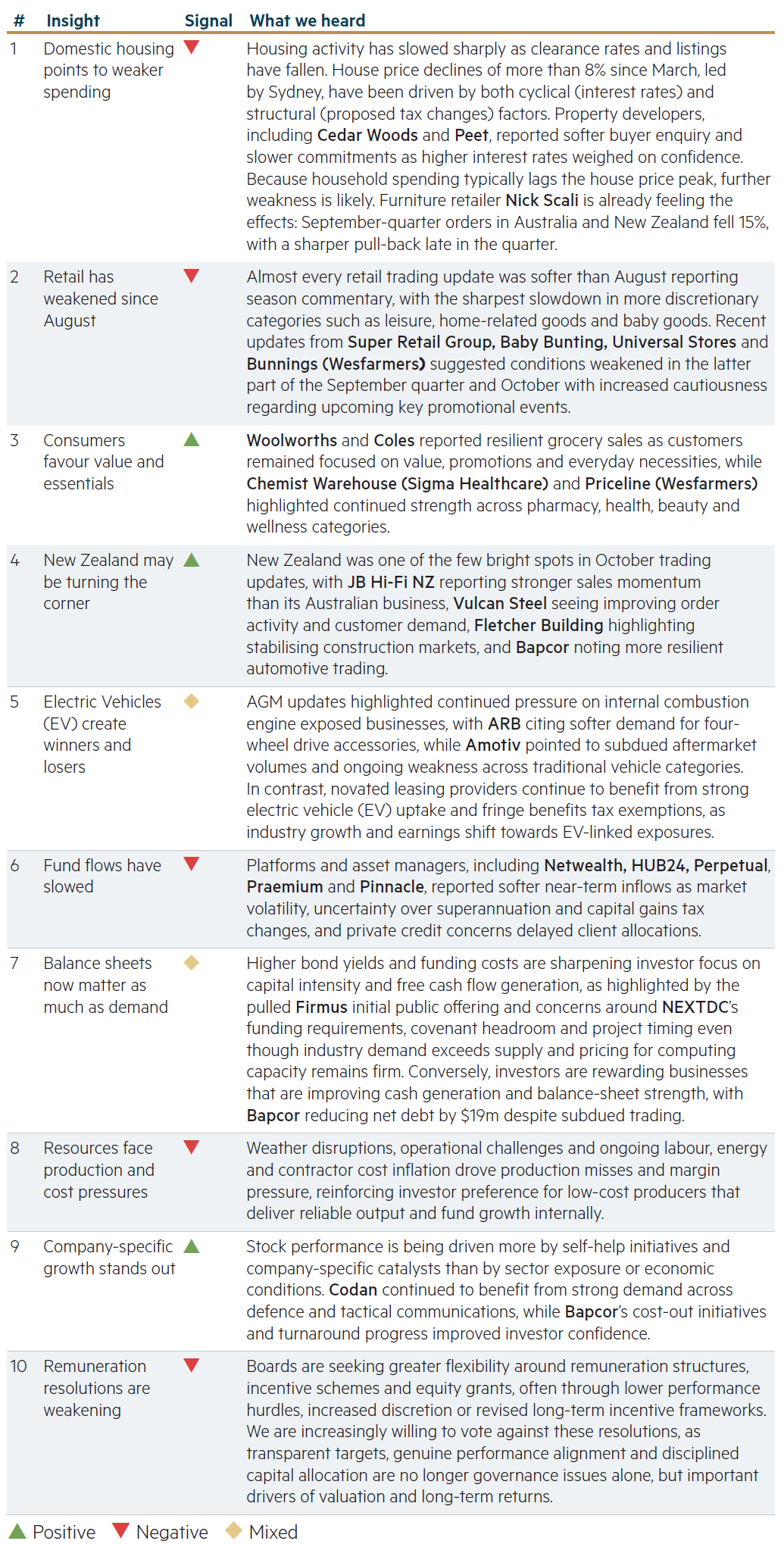
AGM season so far: 10 key investment insights
Positioning for earnings, not interest rates
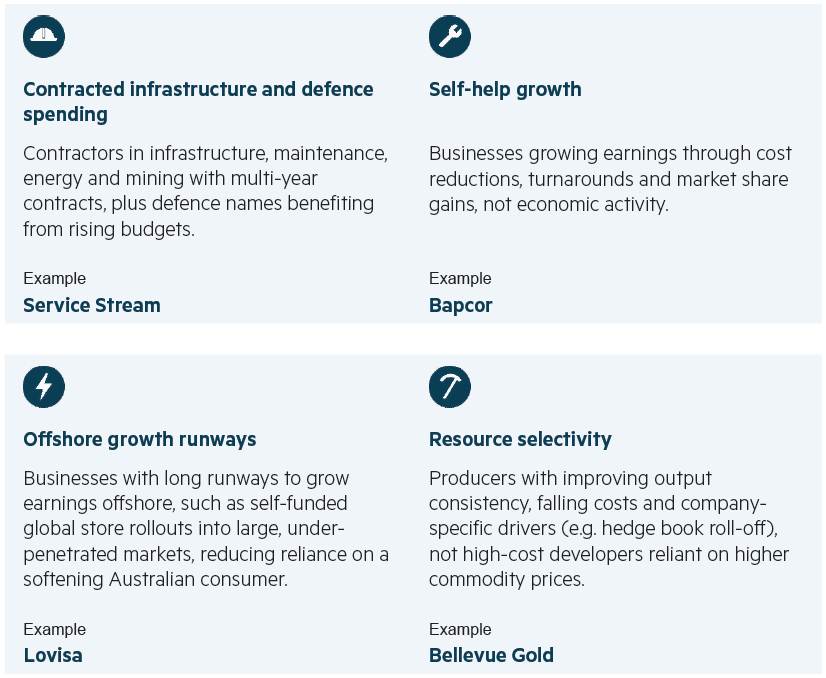
We assess companies individually rather than building the Maple-Brown Abbott Australian Small Companies Fund (‘the Fund’) around economic or interest rate forecasts. We believe earnings drive share prices, so we invest in undervalued businesses with resilient medium-term earnings prospects and company-specific growth drivers, avoiding those facing likely earnings downgrades.
Against the current challenging backdrop, we favour established, profitable businesses with net cash or manageable debt that can fund their own growth and have clear reasons for earnings to improve.
Four investment themes and stock examples
Source: Maple-Brown Abbott. Fund positioning as at 30 October 2026. Stock examples are for illustration only and are not recommendations.
Five catalysts that could release the spring
Despite near-term earnings pressure, we see five catalysts that could support an Australian small-cap recovery.
1. Rates nearing their peak: The RBA lifted the cash rate to 4.85% on 3 November – its fifth rise this year and the highest level since 2008. The decision also carried an encouraging message. Three of the nine Board members voted to keep the cash rate unchanged, and the RBA removed its explicit commitment to raise rates further ‘if needed’. In our view, this sets a much higher bar for any further increase, and markets now expect rates to stay broadly flat over the next 12 months. This matters because the economy is already weak: growth is well below trend, unemployment is rising and house prices are falling. Australian small caps may need only an end to rate rises, not rate cuts, to recover.
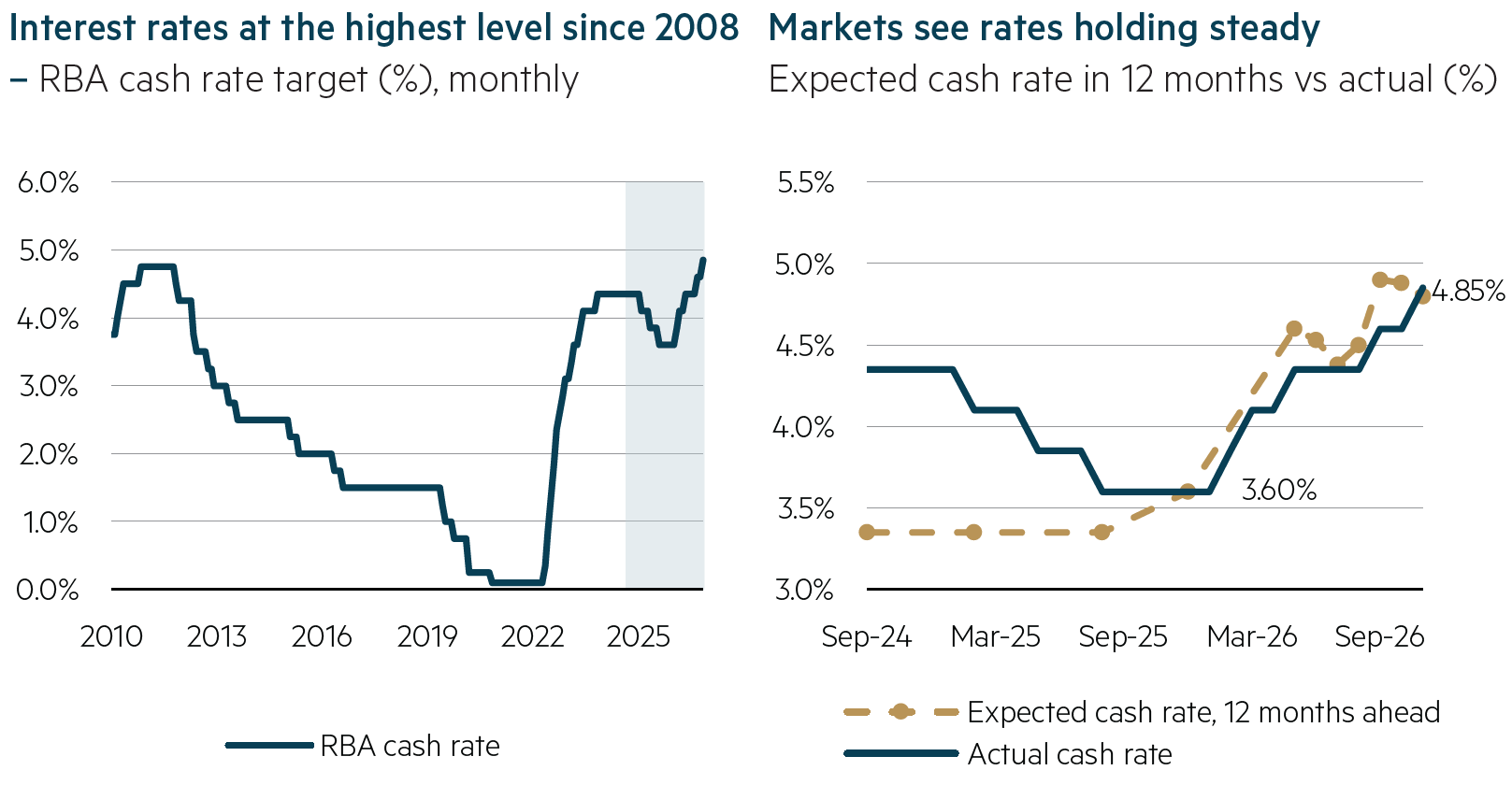
Source (left) : Maple-Brown Abbott, RBA. Shaded area = period shown in right chart. Data as at 3 November 2026.
Source (right): Maple-Brown Abbott, RBA, Reuters poll medians, ASX 30-day cash rate futures, broker research. Data as at 3 November 2026.
2. Compressed valuations: Australian small caps’ forward price-to-earnings ratio is now well below its long-term average, both in absolute terms and relative to large caps.
3. Higher yields than large caps: For the first time since 2002, Australian small caps offer a higher dividend yield than large caps, paying investors to wait.
4. Takeover interest: Takeover activity is concentrated at the smaller end of the market across a range of sectors and has increased since the start of the 2027 financial year, as offshore and private equity buyers see value emerging.
5. Stronger expected earnings growth: Australian small-cap earnings are forecast to grow faster than large-cap earnings in FY27 and FY28.
What could change our view
On the downside, key risks are persistent inflation keeping rates higher for longer or, though less likely after today’s RBA decision, forcing further rate rises, a sharper household spending downturn spreading beyond discretionary retail, tighter funding markets pressuring leveraged businesses, further earnings downgrades that delay the forecast rebound, and valuations staying low for longer if investors continue to favour the liquidity and defensiveness of large caps. Our focus on strong balance sheets and idiosyncratic, company-specific earnings drivers that do not depend on lower rates aims to limit the impact.
On the upside, faster-rising unemployment or cooling inflation could prompt the RBA to shift from holding to easing earlier than markets anticipate, although a turn driven by rising unemployment would also mean weaker demand and further earnings pressure before rate relief feeds through. Australian small caps have historically rallied hard on an early turn in the rate cycle, which could leave underweight investors behind. We believe the Fund’s self-help holdings, which stand to benefit from both company-led improvements and a domestic recovery, provide exposure to that upside.
More broadly, the Fund is built as a balanced portfolio of idiosyncratic stock exposures rather than around any particular macro or sector view, aiming to outperform in most market environments, whether the rate cycle turns early or late.
The bottom line: tough conditions, but a tightly coiled spring
Conditions remain tough, but they can turn quickly: past episodes of deep underperformance have been followed by sharp recoveries, valuations already reflect considerable bad news and earnings are forecast to rebound. A recovery may not be immediate, but when the spring releases, we believe Australian small caps could move faster than many expect.
For investors, now may be an opportune time to review allocations to Australian small caps against their long-term targets.
Disclaimer
This video is prepared by Antipodes Partners Limited (‘Antipodes’) (ABN 29 602 042 035, AFSL 481 580) as the Investment Manager of the Maple-Brown Abbott Australian Small Companies Fund (ARSN 658 552 688) (‘the Fund’). Maple-Brown Abbott Limited (‘MBAL’) (ABN 73 001 208 564, AFSL 237 296), is the Responsible Entity of the Fund. MBAL and Antipodes are subsidiaries of Antipodes Partners Holding Limited (ABN 91 602 828 526). The Product Disclosure Statement (‘PDS’) and Target Market Determination (‘TMD’) of the relevant Fund are available via the links below. Any potential investor should consider the PDS and TMD before deciding whether to acquire, or continue to hold units in, the Fund.
Link to the PDS
Link to the TMD
For historic TMDs please contact MBAL’s Client Service Phone +61 2 8059 7671 or Email invest@maple-brownabbott.com.
This information is for general information only. It is not intended as a securities recommendation or statement of opinion intended to influence a person or persons in making a decision in relation to investment. It has been prepared without taking account of any person’s objectives, financial situation or needs. Any persons relying on this information should obtain professional advice before doing so. Past performance is for illustrative purposes only and is not indicative of future performance.
Whilst Antipodes and MBAL believe the information contained is reliable, no warranty is given as to its accuracy, reliability or completeness and persons relying on this information do so at their own risk. Subject to any liability which cannot be excluded under the relevant laws, Antipodes and MBAL disclaim all liability to any person relying on the information contained on this webpage in respect of any loss or damage (including consequential loss or damage), however caused, which may be suffered or arise directly or indirectly in respect of such information. This disclaimer extends to any entity that may distribute this communication. Any opinions and forecasts reflect the judgment and assumptions of Antipodes and its representatives on the basis of information available as at the date of publication and may later change without notice. Any projections are estimates only and may not be realised in the future. Unauthorised use, copying, distribution, replication, posting, transmitting, publication, display, or reproduction in whole or in part of the information contained in this communication is prohibited without obtaining prior written permission from Antipodes. For more information, including our Financial Services Guide, visit maple-brownabbott.com.

Phillip
Interested in investing with us?
Investment Insights

Australian small caps: a coiled spring so far this AGM season
Dougal Maple-Brown’s shocking prediction


Data center growth in Iberia


2026 Australian Small Companies ESG Report