

Research trip insights: data center growth in Iberia and increasing battery storage opportunities globally
- Europe’s data center growth is happening in Iberia. Portugal has grid requests four times its peak electricity demand, with permitted demand in Spain at over 25% of its peak, supporting significant generation and grid investment across the peninsula.
- Developers see better returns on batteries than on standalone wind and solar. The falling cost of batteries coupled with wider intraday electricity price spreads and increased demand for flexible generation has improved the economics of batteries relative to standalone wind and solar in renewable-heavy markets.
- Batteries have the potential to address affordability for consumers in the US. Exelon is proposing an up to 500 MW utility-owned battery project in New Jersey at no cost to customers through to at least 2035, helping to bridge the gap to new generation, with plans to replicate the strategy in other states.
There is no shortage of investment opportunities in the current environment of strong and growing electricity demand, but what is clear is that the nature of the opportunities continue to evolve. In September, we travelled to Europe and the US to meet with utilities, regulators, renewable developers and data center developers, and to undertake site visits of infrastructure assets to learn firsthand from experts on where the greatest opportunities and risks exist. This note explores two key themes from the trip: the growth in Iberian data centers and the increasing investment opportunities for battery storage.
We currently own Energias de Portugal (EDP), a Portuguese-based integrated electric utility that owns 71.4% of separately listed renewable developer EDP Renewables (EDPR). EDPR has a 20.5 GW portfolio of installed renewable capacity primarily across the US and Europe. We also own a position in Exelon, a US regulated electric and gas utility serving 10.9 million customers across five states and the District of Columbia.
Iberian data center growth
While data center growth has been concentrated in the US and continues to remain strong, development is accelerating across Europe, with interest in Spain and Portugal appearing particularly strong. Permitted demand in Spain currently represents over 25% of the country’s peak demand of ~45 GW; while in Portugal large customer grid connection requests are over 40 GW, equivalent to four times the country’s peak demand of ~10 GW. Actual demand will be limited by grid constraints, but these numbers point to the investment opportunities ahead for Iberian electric utilities.
In Portugal, we visited MERLIN’s 180 MW data center campus development at Castanheira do Ribatejo, approximately 30 kilometres north-east of Lisbon. Phase 1 of the site will connect to EDP’s distribution network and will also be directly supplied by EDP’s largest decentralised solar site, which may reach up to 100 MW. Phase 2 will connect to Redes Energéticas Nacionais’ (REN) electric transmission network. MERLIN told us the site could be developed further, to as much as 900 MW. That would require additional generation, and MERLIN is already in discussions with EDP about supplying some of it.
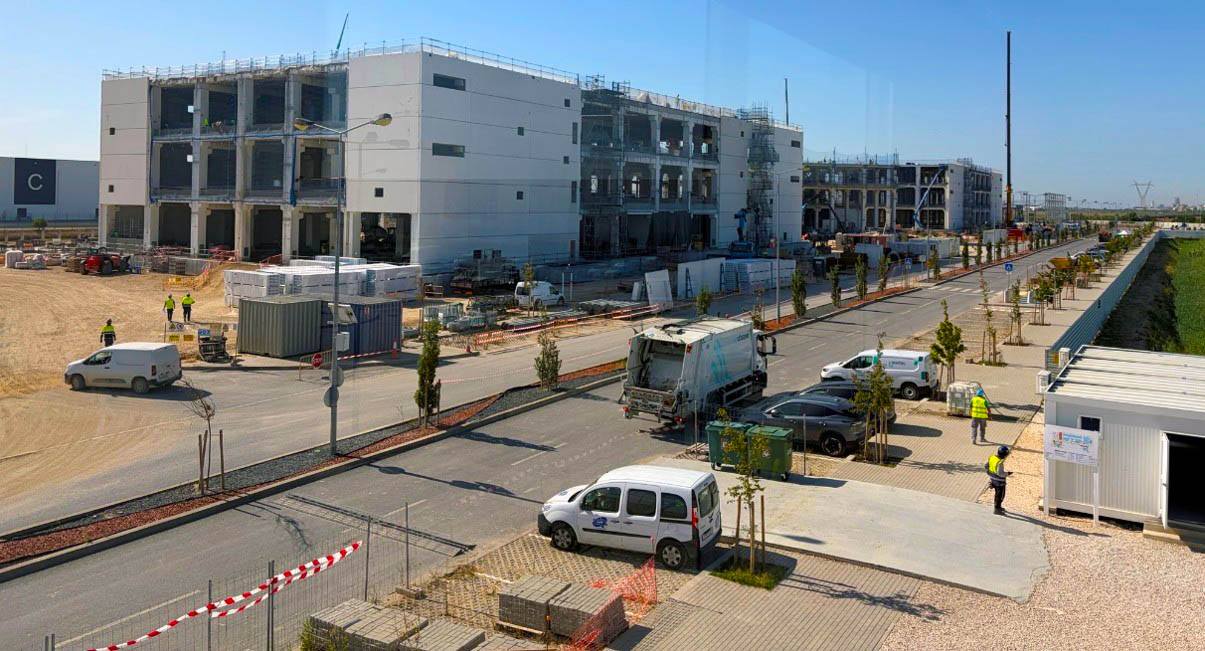
MERLIN’s Castanheira do Ribatejo data center campus: construction progress on phase 1 as of 3 September 2026.
We also visited the nearby Carregado Combined Cycle Gas Turbine (CCGT) plant, which sits adjacent to the site of a decommissioned fuel-oil generation plant which EDP noted could be an ideal location for another data center given access to transmission and generation in the area. This is a prime site that EDP may have bid for transmission grid connection as part of a procurement dedicated to data center development, which it could later monetise as powered land.
In Spain, the discussions were primarily centered on the government’s draft Royal Decree that would require data centers to source at least 80% of their hourly electricity consumption from new renewable generation. Some viewed this as virtually impossible to meet in the absence of new wind development and expected the proposal to be watered down. In any case, Iberdrola expects to be well positioned given its ability to build and supply the renewable generation for customers.
Beyond supporting data centers, utilities made clear that the Iberian networks required significant additional investments to enable broader electrification and as they anticipate a period of heavy asset replacement. Additional resiliency investments may also be needed in response to the severe storms earlier this year and the blackout in 2025. In response, the Portuguese regulator raised the allowed return on rate base, which along with incentives provides EDP with sufficient remuneration to enable greater investment. In fact, the company noted that Portugal’s allowed return relative to its long-term sovereign debt cost was now among one of the most attractive in Europe – which should attract incremental capital for investment.
Growing battery storage investment opportunity
Throughout our meetings on the trip it was clear that battery storage opportunities were growing as their costs were coming down and as the need to balance electric grids were growing. Beyond becoming more economic to build, we also learned of innovative ways in which US regulated utilities are proposing to address both affordability and reliability concerns by deploying batteries.
Heavy solar penetration in Iberia has depressed midday electricity prices, widening intraday spreads, and increased the demand for flexibility, which has driven elevated costs of ancillary services – both of which can be addressed with additional battery storage. We visited EDPR’s largest solar plant in Europe, the 202 MWp Cerca Solar PV Park, that alongside other Iberian solar plants are exposed to curtailment challenges. The key opportunity discussed was a project to add a 30 MW/120 MWh battery to the site primarily given its ability to mitigate price cannibalisation and overcome grid curtailment. More broadly, it was clear that renewable developers increasingly see more favourable returns on storage projects, relative to standalone wind and solar, which is expected to support continued strong growth in the technology over the next few years.
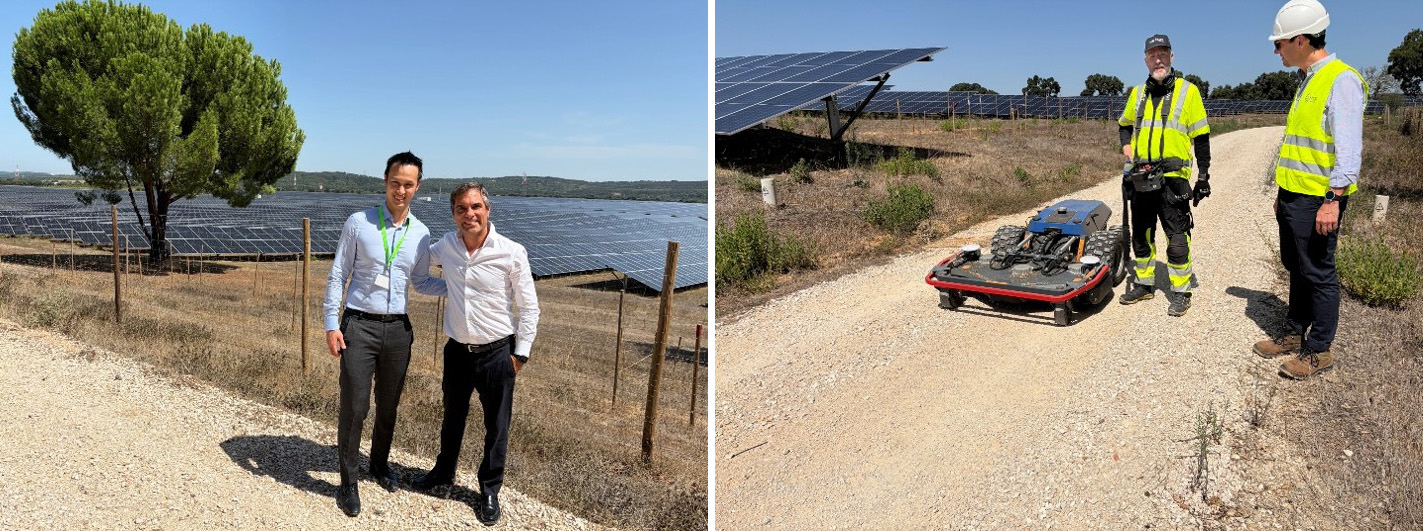
EDPR’s 202 MWp Cerca Solar PV Park.
Left – Andrew Duong with Miguel Viana (EDP Head of Investor Relations);
Right – autonomous robotic vegetation management demonstration with Redo Robotics
In the US, regulated utilities are also seeing substantial opportunities to add battery storage to their investment plans. Among the conversations, we found Exelon’s proposal for an up to 500 MW of utility-owned battery project in New Jersey particularly interesting, because of its ability to bridge the gap to new generation without any impact on customer bills at least through to 2035. The company can do this by taking advantage of available investment tax credits on storage (which remain eligible into the 2030s, unlike solar and wind) and by recognising these credits upfront for the benefit of customers while still earning a return on the net investment added to its rate base. A peer utility was unsure how Exelon could achieve this, given its view that the regulator does not want utility-owned generation. We believe that if the proposal is executed successfully it could become a blueprint for accelerating regulated storage investment across other states. Management noted that they intend to replicate the proposal across other states in the PJM Interconnection market, with Maryland and Delaware already permitting the structure, while Pennsylvania would require new legislation. In an environment where affordability constrains almost every form of investment, rate base investment with no customer bill impact is a clear positive for the utility.
In summary
Strong electric demand growth is now supporting long-term visibility in electric infrastructure investments, but the opportunities within it keep evolving. Our trip made clear that the Iberian network opportunity and the growing opportunities within battery storage appear to be under-appreciated by the market, which remains heavily focused on headline data center capacity growth in the US, additional gas turbine generation investment and regulatory risks primarily around affordability.
Disclaimer
This information is prepared by Antipodes Partners Limited (“Antipodes”) (ABN 29 602 042 035, AFSL 481 580) as the Investment Manager of the Maple-Brown Abbott Global Listed Infrastructure Fund (ARSN 164 901 982) (‘the Fund’). Maple-Brown Abbott Limited (‘MBAL’) (ABN 73 001 208 564, AFSL 237296), is the Responsible Entity of the Fund. MBAL and Antipodes are subsidiaries of Antipodes Partners Holding Limited (ABN 91 602 828 526). The Product Disclosure Statement (‘PDS’) and Target Market Determination (‘TMD’) of the relevant Fund are available via the links below. Any potential investor should consider the PDS and TMD before deciding whether to acquire, or continue to hold units in, the Fund.
Link to the PDS
Link to the TMD
For historic TMDs please contact MBAL’s Client Service Phone +61 2 8059 7671 or Email invest@maple-brownabbott.com.
This information is for general information only. It is not intended as a securities recommendation or statement of opinion intended to influence a person or persons in making a decision in relation to investment. It has been prepared without taking account of any person’s objectives, financial situation or needs. Any persons relying on this information should obtain professional advice before doing so. Past performance is for illustrative purposes only and is not indicative of future performance.
Whilst Antipodes and MBAL believe the information contained is reliable, no warranty is given as to its accuracy, reliability or completeness and persons relying on this information do so at their own risk. Subject to any liability which cannot be excluded under the relevant laws, Antipodes and MBAL disclaim all liability to any person relying on the information contained on this document in respect of any loss or damage (including consequential loss or damage), however caused, which may be suffered or arise directly or indirectly in respect of such information. This disclaimer extends to any entity that may distribute this communication. Any opinions and forecasts reflect the judgment and assumptions of Antipodes and its representatives on the basis of information available as at the date of publication and may later change without notice. Any projections are estimates only and may not be realised in the future. Unauthorised use, copying, distribution, replication, posting, transmitting, publication, display, or reproduction in whole or in part of the information contained in this communication is prohibited without obtaining prior written permission from Antipodes. For more information, including our Financial Services Guide, visit maple-brownabbott.com.

Andrew joined Maple-Brown Abbott in January 2017 as Senior Research Associate and was appointed Investment Analyst in 2019 and most recently Portfolio Manager in 2022. Andrew is responsible for covering the midstream, renewables and diversified utilities. He is also chair of the Macroeconomic Committee. Before joining Maple-Brown Abbott, Andrew spent six years at the Reserve Bank of Australia (RBA), including an 18-month secondment to the Bank of England. As a Senior Analyst in the International Financial Markets division of the RBA, he was responsible for analysing developments in international markets for the bank’s monetary policy
Andrew
Interested in investing with us?
Investment Insights

Dougal Maple-Brown’s shocking prediction


Data center growth in Iberia

2026 Australian Small Companies ESG Report


Beyond the chips five thematics from our US trip