

Getting out of the office to meet management teams and conduct site tours is one of the most engaging and essential responsibilities for the investment team. Georgia and Steve’s recent visit to the 407 Express Toll Route (ETR) toll road in Toronto, Canada, reinforced our view that toll roads are more than just bond proxies; they highlight how concession infrastructure can provide exposure to economic growth and can create value even when interest rates are rising.
The 407 ETR, a major toll road in Toronto, spans 108 km and has seen over 525 km of additional lanes added since 1999, all without public funds. The concession for this asset expires in 2098. Ferrovial, a holding in the Portfolio, owns 43% of the 407 ETR.
Long-term concessions such as the 407 ETR benefit from strong cash flow generation over time, driven by increasing traffic volumes and higher tolls. GDP and population growth drives activity and leads to higher traffic congestion. This in turn increases toll road volumes because people perceive their “value of time” to be greater and have a higher “willingness to pay” tolls to avoid delays.
This demand can be captured by either expanding road capacity (though lead times can be lengthy) or implementing variable pricing models, such as that used on the 407 ETR and other Managed Lanes in North America. The resulting revenue growth can be powerful and can outweigh the impact of higher discount rates. Topline growth typically translates to bottom-line and dividend growth, given toll roads’ high operating leverage (high margins) and financial leverage (long-term, fixed-rate debt).
Post-pandemic traffic patterns on the 407 ETR are evolving. While weekday trips remain below 2019 levels, total vehicle kilometres travelled (VKT) have returned to pre-pandemic levels, thanks to more frequent longer trips and a shift toward weekend travel. Average peak tolls have risen significantly, with a 15% increase in February 2024.1 Pricing is a key value driver for the 407 ETR, and it has flexibility to set tolls by segment and time of day to manage traffic.
Looking ahead, lane expansions are another key catalyst for value creation. The 407 ETR still has room for growth, especially in segments C1 and C7, with plans to add one more lane in each direction by 2030. Western and eastern sections also have potential for expansion through to 2050, triggered by traffic thresholds and to maintain service quality.
Operating under a social license is crucial for infrastructure assets like the 407 ETR. Customer satisfaction, a priority for management, temporarily dipped with the February toll increase but has since recovered. Over 25 years, the 407 ETR has provided substantial community benefits, contributing $23 billion in economic value, including $19 billion in user benefits like time savings, reliability, and reduced vehicle operating costs, as well as $3.5 billion in productivity and safety-related savings.”2
The 407 ETR management team is mindful of climate change risks that could impact road surfaces long-term, such as winter storms, heat waves, and flash floods. In collaboration with government efforts, the 407 ETR has planted 10,000 trees along the highway, with plans for more annually, and aims to reduce emissions by 25% by 2030. Although there are currently no plans for EV charging stations, they may be considered near entry and exit ramps in the future.
The meeting with the 407 ETR management team reaffirmed the toll road’s attractive features for long-term investors, including strategic location, toll growth that captures value of time and willingness to pay, high operating leverage, limited competition, and resilience during economic downturns. These qualities support the 407 ETR as a long-term investment for Ferrovial, being a key holding in the Portfolio.
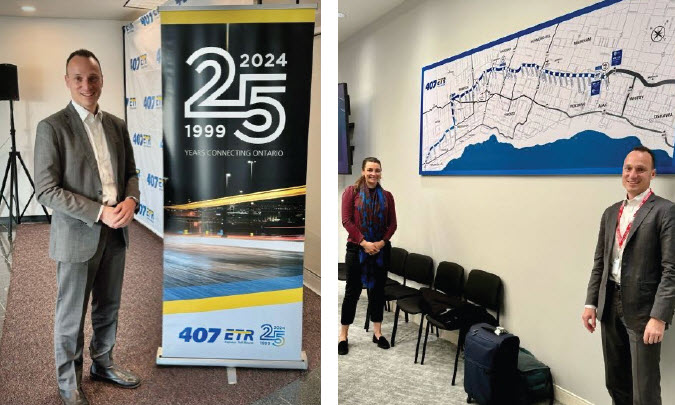
Steven Kempler and Georgia Hall at the Boardroom of the 407 ETR, Toronto.
1 ETR-announces-2024-rate-schedule-following-four-year-rate-freeze
2 Impact of four year rate freeze
Disclaimer
This information was prepared and issued by Maple-Brown Abbott Ltd ABN 73 001 208 564, AFSL No. 237296 (“MBA”). This information is general information only and it does not have regard to any person’s investment objectives, financial situation or needs. Before making any investment decision, you should seek independent investment, legal, tax, accounting or other professional advice as appropriate, and obtain the relevant Product Disclosure Statement and Target Market Determination for any financial product you are considering. Past performance is not a reliable indicator of future performance. Any views expressed on individual stocks or other investments, or any forecasts or estimates, are point in time views and may be based on certain assumptions and qualifications not set out in part or in full in this information. The views and opinions contained herein are those of the authors as at the date of publication and are subject to change due to market and other conditions. Such views and opinions may not necessarily represent those expressed or reflected in other MBA communications, strategies or funds. Any companies, securities and or/case studies referenced or discussed are used only for illustrative purposes. The information provided is not a recommendation for any particular security or strategy, and is not an indication of the trading intent of MBA. Information derived from sources is believed to be accurate, however such information has not been independently verified and may be subject to assumptions and qualifications compiled by the relevant source and this information does not purport to provide a complete description of all or any such assumptions and qualifications. To the extent permitted by law, neither MBA, nor any of its related parties, directors or employees, make any representation or warranty as to the accuracy, completeness, reasonableness or reliability of the information contained herein, or accept liability or responsibility for any losses, whether direct, indirect or consequential, relating to, or arising from, the use or reliance on any part of this information. This information is current at 14 October 2024 and is subject to change at any time without notice. © 2024 Maple-Brown Abbott Limited.

Steven joined Maple-Brown Abbott in 2012 and is co-founder and portfolio manager of global listed infrastructure. Prior to Maple-Brown Abbott, he spent six years in Macquarie’s Global Listed Infrastructure team as an investment analyst covering infrastructure and utilities in the Asia Pacific region. He was later appointed as a joint Portfolio Manager for Macquarie’s Emerging Market Listed Infrastructure strategy. Prior to joining Macquarie, Steven worked briefly within Rothschild’s investment banking division in London, specifically on debt and mezzanine private placement transactions. Steven is an airports expert and is responsible for the coverage of the team’s airport investments around the globe, the transportation infrastructure and communication infrastructure assets.
Board and committee membership:
Maple-Brown Abbott Global Listed Infrastructure Pty Limited
Steven

Georgia
Interested in investing with us?
How to invest in
Global listed infrastructure
- Targeting companies with stable, inflation-linked cashflows that grow over time
- Integrating ESG and sustainability factors throughout the investment process
- Experienced team including co-founders who have worked together for more than 17 years
We use a tight definition of infrastructure assets with low-volatility cashflows and inflation protection to achieve diversification benefits with other asset classes, such as global equities.

How to invest in
Global listed infrastructure
- Targeting companies with stable, inflation-linked cashflows that grow over time
- Integrating ESG and sustainability factors throughout the investment process
- Experienced team including co-founders who have worked together for more than 17 years
We use a tight definition of infrastructure assets with low-volatility cashflows and inflation protection to achieve diversification benefits with other asset classes, such as global equities.
Investment Insights

Data center growth in Iberia

Infrastructure investing: what the label doesn’t tell you

Australian small caps: August 2026 reporting season wrap


2026 Australian Small Companies ESG Report