
This interview was first published on Livewire markets and was recorded on Monday, 2 February 2026.
TIME CODES
00:03 – Introduction: Valuations, volatility, and why markets are de-rating
00:42 – The de-rating of market darlings: PE spreads compressing
01:40 – The outlook for value: Why the market still looks expensive
03:52 – How the base case could be wrong: US growth, Trump, and rates
05:11 – Portfolio positioning: Defensive setup and sector tilts
06:52 – Gold and silver: Why sell-offs still don’t equal value
07:35 – When quality gets mispriced: CSL and Woolworths
09:22 – Capital discipline and value traps: Leverage risks
11:29 – Where alpha came from: ANZ and Amcor
14:14 – A stock sold: Why Brambles no longer stacked up
Valuations are easing and opportunities are emerging. Here’s where a value investor is putting capital to work.
Whilst factors such as growth and momentum have dominated markets in recent years, anyone paying attention will have observed that things are starting to change.
There is a rotation happening literally as you read this, with hot money flowing out of tech and certain commodities. But it’s more than that. The market is waking up to the idea that what has worked in the past won’t work ad infinitum.
To put it more succinctly;
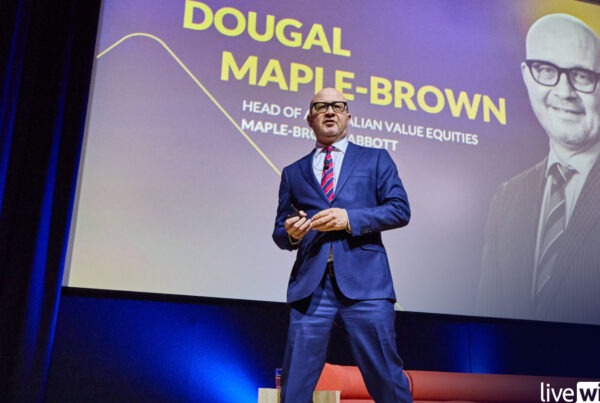
“…Value is already starting to emerge…” says Dougal Maple-Brown, Head of Australian Value Equities at Maple-Brown Abbott
After a powerful rally through late 2025, Australian equities entered 2026 trading near 20-year valuation highs. While headline multiples have come off modestly, Maple-Brown argues the more important development is what is happening beneath the surface. Several of the market’s most popular stocks are already being de-rated, narrowing the valuation gap between expensive and unloved names and reopening the opportunity set for patient, valuation-driven investors.
As he explains, this shift is measurable and already underway:
“…We monitor PE spreads between the rich and the poor. Those spreads have been coming in. You can see stocks like CBA, which peaked at 30 times middle of last year, are now down at 24 or 25. So the de-rating is definitely underway.”
For Maple-Brown, this matters because valuation cycles rarely stop neatly at fair value. Markets that unwind from extremes often overshoot, creating opportunities for investors who remain disciplined as sentiment adjusts to fundamentals.
In our conversation, he explains why Australian equities still look expensive in aggregate, why value has further to run over the next 12 months, and where opportunities are already emerging after years of valuation discipline being tested. Just as importantly, he is clear on where value still does not exist, despite recent pullbacks, and why paying too much for perceived safety remains one of the biggest risks investors face today.
Interview summary
The de-rating of the darlings is already underway
One of the clearest signs that value is beginning to re-emerge is what Dougal Maple-Brown describes as the “de-rating of the darlings” – a framework he uses to track how far the market’s most popular stocks have already unwound from post-COVID valuation extremes.
Rather than looking only at headline indices, Maple-Brown compares peak valuations since early 2020 with where those same stocks trade today. Across a number of former market favourites, valuation compression has already been meaningful.
“…We also monitor PE spreads between the rich and the poor. Those spreads have been coming in… so the de-rating is definitely underway…”
 Source: FactSet, MBA. Peak P/E: highest since Jan 2020. Current P/E: as at 31 Dec 2025
Several former market favourites have seen material valuation compression since their post-COVID peaks, though not all now represent value.
The chart provided by Maple-Brown Abbott illustrates this clearly. CSL has fallen from a peak multiple in the mid-40s to the mid-teens. Cochlear (ASX: COH) has de-rated from roughly the high-60s to the mid-30s. REA Group (ASX: REA) has come back from the high-50s to the low-30s. Even traditionally defensive names such as Woolworths and Wesfarmers have seen valuation resets.
While many of these stocks are no longer priced at the extremes reached in the post-COVID period, Maple-Brown is careful to distinguish between valuation compression and true value, noting that not every falling multiple creates an opportunity.
Value is re-emerging, even if the market is not cheap
At the market level, valuations have eased but remain elevated. The ASX peaked around 20 times forward earnings and has since fallen closer to 18, still well above the long-term average of roughly 14.
History suggests valuation adjustments rarely stop neatly at average levels:
“…Whether it be a market level or a stock level, they rarely come back to average and stay there. If they’re coming from 20, they generally keep going down…”
That dynamic underpins Maple-Brown’s confidence that value still has room to run as dispersion between expensive and cheap stocks continues to narrow.
Portfolio positioning reflects valuation, not forecasts
The portfolio remains defensively positioned, but that defensiveness is a by-product of valuation rather than a macro call. Maple-Brown holds elevated cash, is underweight banks and high-growth stocks, and favours businesses that can hold up if market risks materialise.
“…It’s based on valuation, but it’s got the added benefit that if one of the risks comes to fruition, the underlying businesses that we own are pretty defensive…”
This approach preserves flexibility while allowing the portfolio to capitalise on valuation dislocations as they emerge.
Energy stands out as the clearest commodity opportunity
Energy is the only commodity sector where Maple-Brown sees clear long-term value. While iron ore, copper, gold and rare earths all trade well above his assessment of long-term prices, energy stands apart.
“…Energy was the only commodity trading a long way below our long-term price, whereas iron ore is about $40 above where we think it is long-term…”
Despite weak sentiment, demand remains near record highs, supporting the medium-term investment case.
When de-rating turns into opportunity: CSL, Woolworths, ANZ and Amcor
In some cases, valuation compression has been sufficient to create genuine opportunity. CSL Limited (ASX: CSL) is the clearest example.
“…CSL peaked at almost 55 times and today it trades on 16 or 17 times. Quite unbelievable. Not surprisingly, we have bought CSL…”
That magnitude of de-rating has fundamentally altered the risk-reward profile, turning a former market darling into an attractive value opportunity.
Woolworths (ASX: WOW) has also been added after a significant valuation reset. In both cases, the investment decision was driven not by a change in business quality, but by a sharp reduction in expectations.
ANZ Group Holdings (ASX: ANZ) remains a core holding on a relative basis. While it has re-rated from the low-teens to the mid-teens, Maple-Brown still sees it as attractive versus peers.
“…CBA was on 33 times forward earnings and ANZ was on 12 or 13. That gap has closed, but ANZ still looks cheap relative to its peers…”
Amcor (ASX: AMC) is viewed as a low-growth but attractively priced business trading on 10–11 times earnings, with limited disruption risk and manageable acquisition execution.
Where value still does not exist
Despite recent pullbacks, Maple-Brown remains cautious on stocks where valuations still imply optimistic growth assumptions. Commonwealth Bank (ASX: CBA), for example, has de-rated from around 30 times to the mid-20s, but remains expensive given modest earnings growth.
“…For a stock with minimal earnings growth, that still looks pretty rich to us…”
Similarly, Wesfarmers (ASX: WES) has come back from the high-30s to the low-30s, but Maple-Brown sees little justification for paying more than 30 times earnings for low-single-digit growth.
Gold and silver also remain well above levels that would constitute value, even after sharp short-term corrections.
Disclaimer: This information was prepared and issued by Maple-Brown Abbott Ltd ABN 73 001 208 564, AFSL No. 237296 (“MBA”). This information is general information only and it does not have regard to any person’s investment objectives, financial situation or needs. Before making any investment decision, you should seek independent investment, legal, tax, accounting or other professional advice as appropriate, and obtain the relevant Product Disclosure Statement and Target Market Determination for any financial product you are considering. This information does not constitute an offer or solicitation by anyone in any jurisdiction. Past performance is not a reliable indicator of future performance. Any views expressed on individual stocks or other investments, or any forecasts or estimates, are point in time views and may be based on certain assumptions and qualifications not set out in part or in full in this information. The views and opinions contained herein are those of the authors as at the date of publication and are subject to change due to market and other conditions. Such views and opinions may not necessarily represent those expressed or reflected in other MBA communications, strategies or funds. Any companies, securities and or/case studies referenced or discussed are used only for illustrative purposes. The information provided is not a recommendation for any particular security or strategy, and is not an indication of the trading intent of MBA. Information derived from sources is believed to be accurate, however such information has not been independently verified and may be subject to assumptions and qualifications compiled by the relevant source and this information does not purport to provide a complete description of all or any such assumptions and qualifications. To the extent permitted by law, neither MBA, nor any of its related parties, directors or employees, make any representation or warranty as to the accuracy, completeness, reasonableness or reliability of the information contained herein, or accept liability or responsibility for any losses, whether direct, indirect or consequential, relating to, or arising from, the use or reliance on any part of this information. This information is current at 2 February 2026 and is subject to change at any time without notice. © 2026 Maple-Brown Abbott Limited.

Dougal joined Maple-Brown Abbott in 2001 as an equity analyst. He is currently a portfolio manager and equities analyst. Dougal was an Executive Director from July 2009 to October 2018. Dougal’s responsibilities include equity analysis and portfolio management, including managing a large number of institutional and retail accounts. He attended the Advanced Management Program at Harvard Business School in 2014. Prior to joining Maple-Brown Abbott Dougal worked in a national law firm and at an international investment bank.
Board and committee membership:
Asset Allocation Committee
Dougal
Interested in investing with us?
Investment Insights
Dougal Maple-Brown’s shocking prediction

Data center growth in Iberia


2026 Australian Small Companies ESG Report


Beyond the chips five thematics from our US trip