
Transcript
The performance of Australian small caps this reporting season has been strong. The S&P/ASX Small Ordinaries Index returned over 5% during the month of August. The median stock return was 3.5%, although the largest stocks in the index, particularly those resource related, did particularly well over this reporting period, which drove up the index return on a market capitalisation basis.
Australian small caps performed strongly in August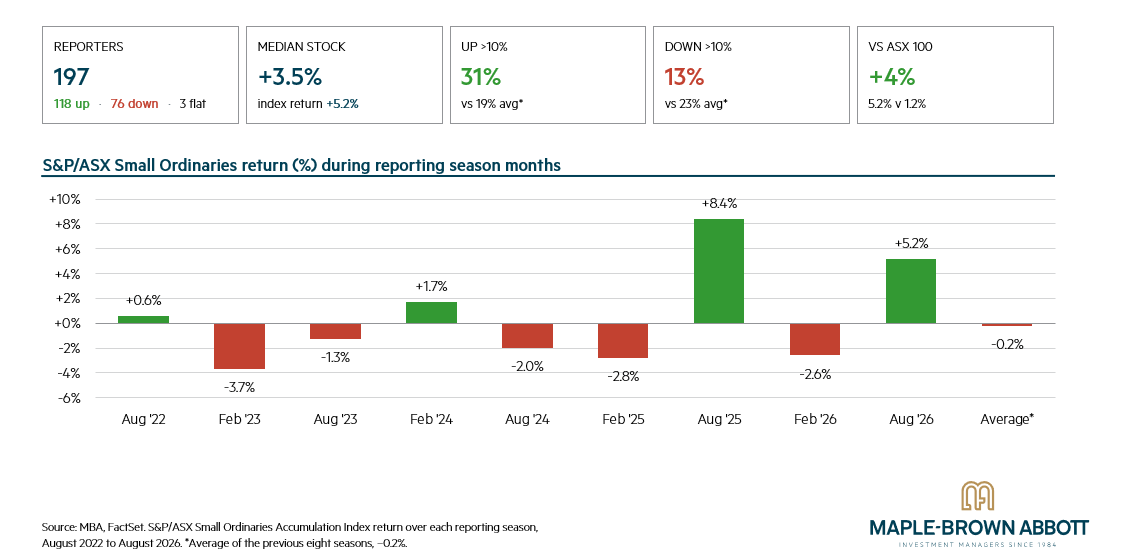
This was a reversal of what we saw in February 2026, with many of the headwinds, particularly interest rate increases, that have come through in the first half of this calendar year now moderating, which is more favourable for Australian small caps.
Also, what you saw in this reporting season was approximately 30% of stocks generating a return of above 10%. This is a lot higher than what we see on average. Those stocks which fell more than 10% made up only 13% of stocks in the index, which is a lot lower. Those companies included stocks which were particularly hampered by a tougher consumer environment. Higher interest rates have led to housing related stocks struggling over this reporting period, along with retail related stocks, while auto stocks also underperformed this reporting season.
Resources drove Australian small caps performance higher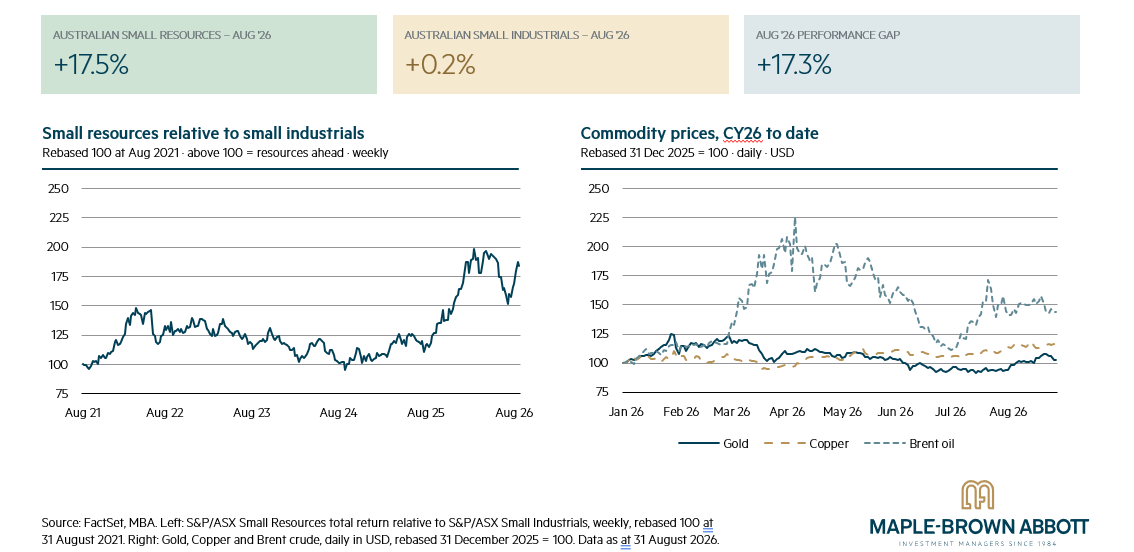
What was particularly interesting is you saw a catch up of Australian small caps relative to their large cap counterparts, outperforming the ASX 100 by roughly 4 percentage points over the month of August. Key reasons for that: the interest rate environment is now more favourable, and fewer liquidity concerns have seen money being reallocated to the smaller end of the market.
Resources did the heavy lifting this reporting period for Australian small caps. Small resources returned a whopping 17.5% over the month of August, and that compared to a largely flat return for small industrials.
Takeover activity elevated for Australian small caps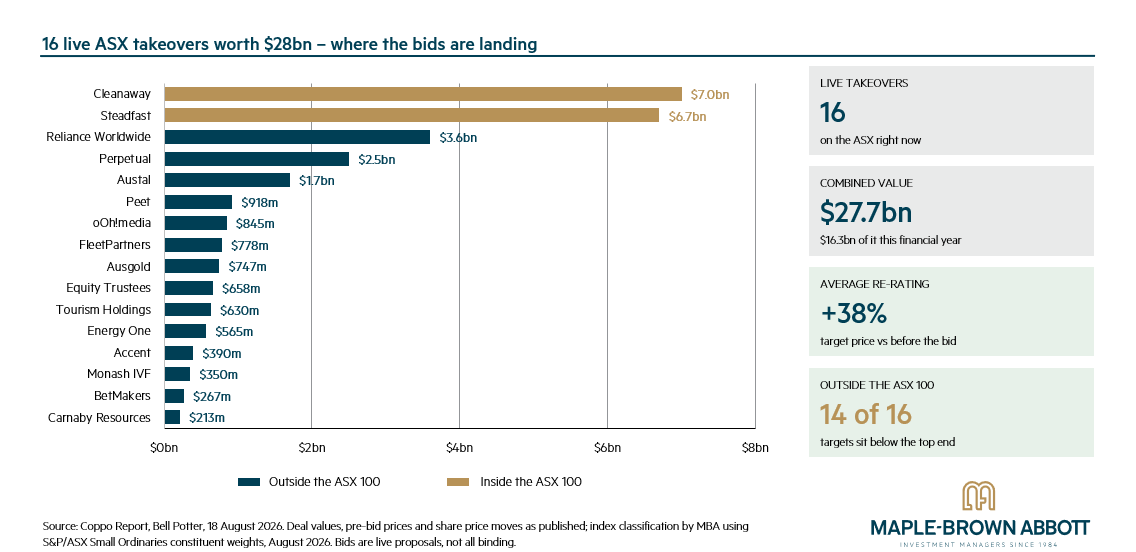
What drove that? Firstly, it has been the gold price, which has seen a bounce back of roughly 10% over the month of August. The key driver of that has not been company specific or project specific, but rather macro and policy driven decisions, which has seen the gold price go up. We have seen coordinated intervention by US and Japanese authorities to stabilise the yen, as well as the US Treasury increasing its buybacks of long dated treasuries, which has put some fuel under the gold price.
What is even more interesting is the gold equity performance has been multiples of the gold price appreciation, with many stocks increasing anywhere between 30% and 50% over the August month.
Australian small cap valuations look compelling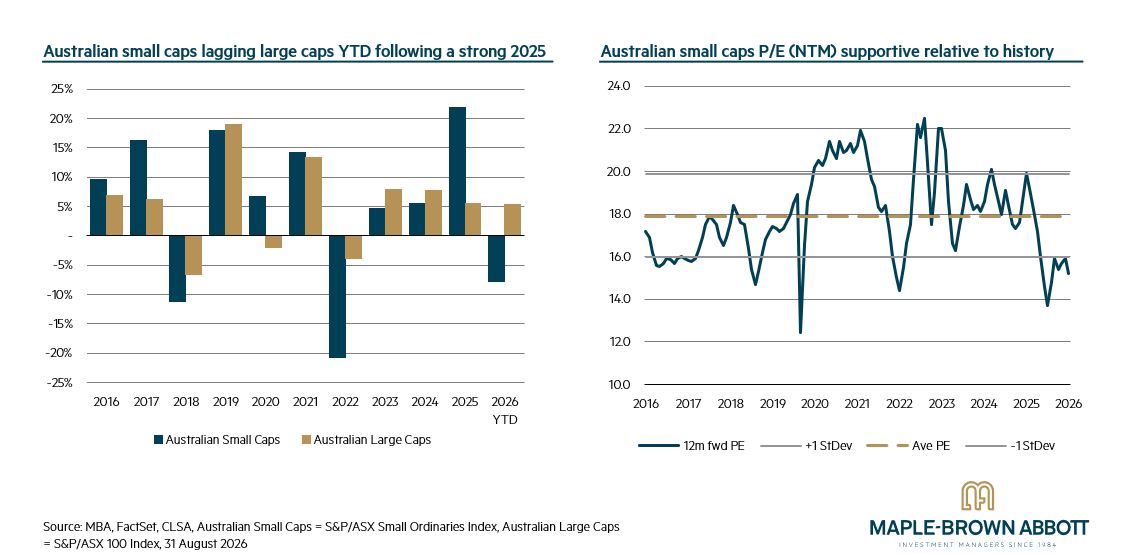
The other key area has been uranium stocks. We continue to be in what we believe is a nuclear renaissance. The spot price and the contract price are now approaching $100 a pound, and they have been on an upward trajectory since 2018.
The other key theme this reporting season has been the increased takeover activity at the smaller end of the Australian equity market. There are dislocations at the smaller end of the market driven firstly by cyclical factors. The increase in interest rates that we saw early this calendar year 2026 has seen a flight of liquidity to the larger end. From a structural perspective, the continual flow of passive money to the larger end of the market has seen valuation dislocations at the smaller end.
What we have seen is private equity and offshore buyers starting to take advantage. For calendar year 2026, we have seen 16 live merger and acquisition (M&A) opportunities being announced to the market. Even more interesting, 14 of those are at the smaller end of the market. Those stock prices on average have gone up 38% post announcement of these deals. And what we have seen is an acceleration of these deals, particularly from July onwards.
Australian small caps have lagged their large cap counterparts since the start of calendar year 2026, although we are seeing the first signs of that moderating and catch up starting to happen at the smaller end of the market. Interest rate increases, which were prevalent over the first half, have now moderated, particularly with expectations being lower for interest rate increases over the next 12 to 18 months. And what we have seen is August being a key period of outperformance starting to come through at the smaller end of the market.
What gives us comfort is the valuation support we see at the smaller end of the market, with small caps trading below one standard deviation versus their long-term average and also trading at a reasonable discount to their Australian equity large cap counterparts. What is even more interesting is the small caps’ earnings growth expected over FY27 and FY28 is above that of Australian large cap equities, which gives us confidence in the outlook for Australian small caps.
Disclaimer
This video is prepared by Antipodes Partners Limited (“Antipodes”) (ABN 29 602 042 035, AFSL 481 580) as the Investment Manager of the Maple-Brown Abbott Australian Small Companies Fund (ARSN 658 552 688) (‘the Fund’). Maple-Brown Abbott Limited (‘MBAL’) (ABN 73 001 208 564, AFSL 237296), is the Responsible Entity of the Fund. MBAL and Antipodes are subsidiaries of Antipodes Partners Holding Limited (ABN 91 602 828 526). The Product Disclosure Statement (‘PDS’) and Target Market Determination (‘TMD’) of the relevant Fund are available via the links below. Any potential investor should consider the PDS and TMD before deciding whether to acquire, or continue to hold units in, the Fund.
Link to the PDS
Link to the TMD
For historic TMDs please contact MBAL’s Client Service Phone +61 2 8059 7671 or Email invest@maple-brownabbott.com.
This information is for general information only. It is not intended as a securities recommendation or statement of opinion intended to influence a person or persons in making a decision in relation to investment. It has been prepared without taking account of any person’s objectives, financial situation or needs. Any persons relying on this information should obtain professional advice before doing so. Past performance is for illustrative purposes only and is not indicative of future performance.
Whilst Antipodes and MBAL believe the information contained is reliable, no warranty is given as to its accuracy, reliability or completeness and persons relying on this information do so at their own risk. Subject to any liability which cannot be excluded under the relevant laws, Antipodes and MBAL disclaim all liability to any person relying on the information contained on this webpage in respect of any loss or damage (including consequential loss or damage), however caused, which may be suffered or arise directly or indirectly in respect of such information. This disclaimer extends to any entity that may distribute this communication. Any opinions and forecasts reflect the judgment and assumptions of Antipodes and its representatives on the basis of information available as at the date of publication and may later change without notice. Any projections are estimates only and may not be realised in the future. Unauthorised use, copying, distribution, replication, posting, transmitting, publication, display, or reproduction in whole or in part of the information contained in this communication is prohibited without obtaining prior written permission from Antipodes. For more information, including our Financial Services Guide, visit maple-brownabbott.com.

Phillip
Interested in investing with us?
Investment Insights
Dougal Maple-Brown’s shocking prediction


Data center growth in Iberia


2026 Australian Small Companies ESG Report


Beyond the chips five thematics from our US trip